Documenting and Sharing Data
Documenting and sharing data for convergence research
Why are data management practices important for convergence science?
Convergent data practices aim to increase access to and responsible use of data across a wide variety of disciplines, sectors, and areas of expertise. Intentional data management and data analysis tool development improves usability and also supports decision makers, community data owners, and small and emergent research institutions who would benefit from improved means to interact with and discern insights from data.
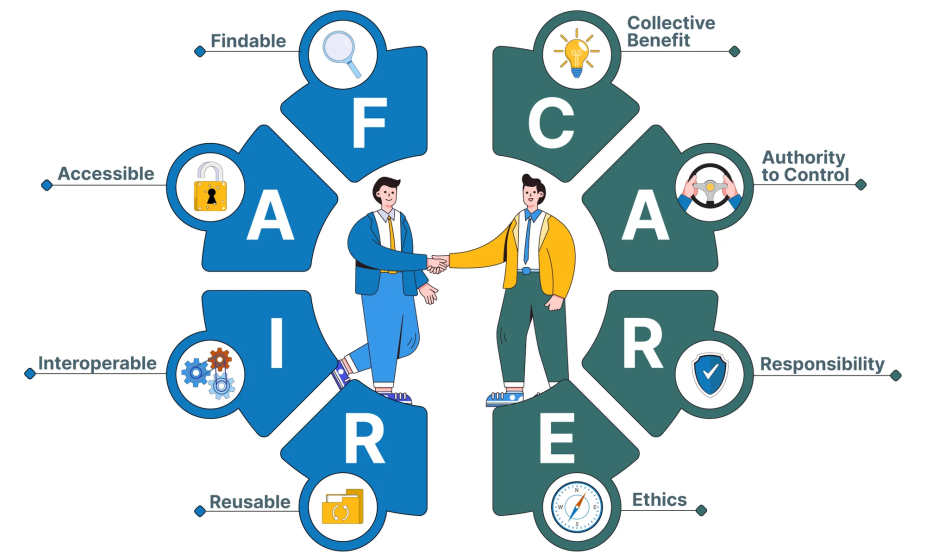
Consider using existing frameworks
FAIR and CARE principles are important frameworks for moving beyond simply posting and publishing data. FAIR principles focus on making data useful and reusable—primarily from a technical and scientific perspective. CARE principles focus on people and purpose. They complement FAIR by adding ethical, relational, and rights-based considerations.
Wilkinson, M., Dumontier, M., Aalbersberg, I. et al. The FAIR Guiding Principles for scientific data management and stewardship. Sci Data 3, 160018 (2016). https://doi.org/10.1038/sdata.2016.18
Expanding how we think about metadata
- Metadata is “data about data”. You’re probably familiar with the following types of metadata;
- Descriptive - explains what the data are (e.g., title, abstract, keywords, creator, subject)
- Structural - describes how data are related and organized (e.g., table schema, file hierarchy)
- Administrative - provides management information (e.g., file type, creation date, access rights, provenance, and version history)
Metadata is a primary method used to tell data’s story. But what is missing from the full story? And how do we balance providing enhanced metadata for convergence research without significantly increasing the burdens that already exist for creating and consuming metadata? These are questions CSP is continuing to explore in collaboration with existing NSF NCAR data management teams.
NSF NCAR scientists are continually improving the ways they manage and share data to support linkage of data across multidisciplinary research domains
NSF NCAR Geoscience Data Exchange (GDEX): NSF NCAR’s trusted platform for sharing and stewarding Earth System Science data and model output.
NSF NCAR Data Commons Initiative: Cross-lab effort transforming how we manage, integrate, and share data: enabling AI/ML readiness, interdisciplinary collaboration, & long-term scientific discovery.
NSF Unidata: Community data facility for sharing data and data management, analysis, and visualization tools and services to enhance Earth system science research and education