NSF NCAR Community Software Facility
Our History
NSF NCAR’s community models have been instrumental in advancing our understanding of weather, climate, geospace, and the Earth system. As an essential tool for understanding our Earth system, modeling complexity continues to escalate as the research community moves toward ultra-high-resolution modeling, ensemble simulations, and the integration of massive volumes of remotely-sensed observations. Additionally, rapid changes and innovations in processor architectures, and the rise of artificial intelligence and machine learning (AI/ML), offer opportunities to improve code performance and add value to Earth system modeling. In 2023, the Community Software Facility concept arose as a way to modernize how NSF NCAR develops, supports, and sustains community models and tools to better meet the current and future needs of staff and the broader Earth System science community.
The CSF Design and Delivery Phase
The goals of the CSF design and delivery phase are to:
1. Define the facility’s programmatic model and structure, ensuring alignment with the NSF NCAR objectives and long-term scientific goals.
2. Engage stakeholders and incorporate feedback to refine priorities, ensure transparency, and build broad support across the community.
3. Drive strategic software and scientific efforts that enhance interoperability and improve software quality and performance, ultimately helping shape and define the CSF.
4. Transition the facility from implementation to full operation, providing sustainable support for our community models.
The Community Software Facility Vision
The Community Software Facility will be an NSF NCAR Center-level program to modernize how we develop, support, and sustain our community models and tools to meet the current and future needs of staff and the broader scientific community.
The program recognizes that NSF NCAR’s software ecosystem is a socio-technical system, an interconnected network of people, processes, and technologies. The success of scientific software development depends as much on communication, trust, and shared understanding as it does on technical rigor. The CSF will serve both as a technical and cultural catalyst, demonstrating that when development processes are designed with people, collaboration, and feedback at their center, the result is not only better software but also a more resilient, innovative, and connected research community.
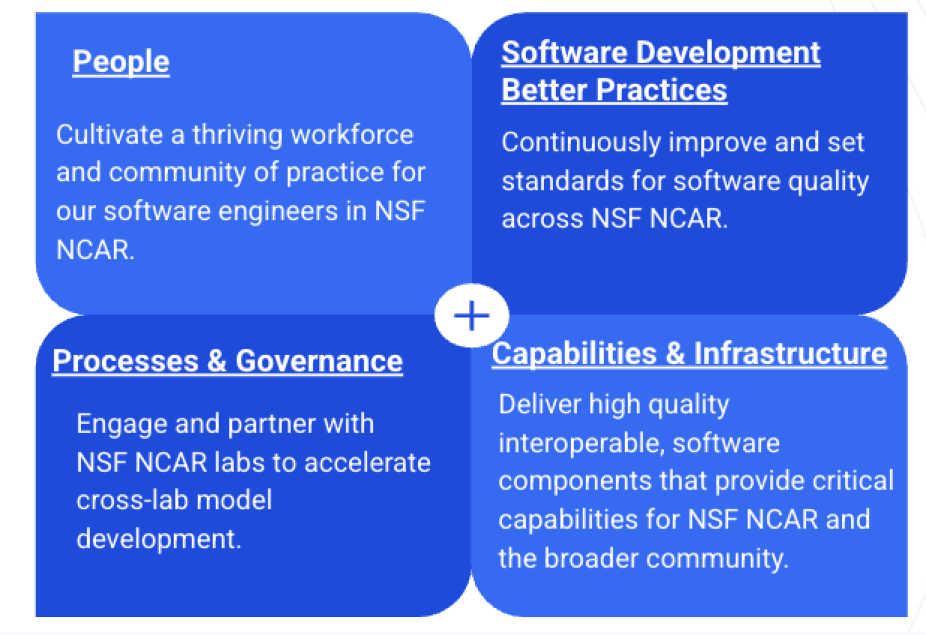
CSF will have four main focus areas:
What Does Success Look Like?
1. Empowerment of software engineers - Empowering software engineers through professional development, leadership opportunities, and decision-making in design structures.
2. The CSF Better Practices are adopted across the organization - Implementing the CSF-recommended better practices across the organization to enhance quality, efficiency, and shared practices.
3. Working across boundaries to solve the next generation of science questions - Collaborating across disciplines and teams to address the scientific challenges and accelerate the process of scientific discovery.
4. Modernizing our software packages - Advancing and updating our software ecosystem to improve performance, scalability, and maintainability



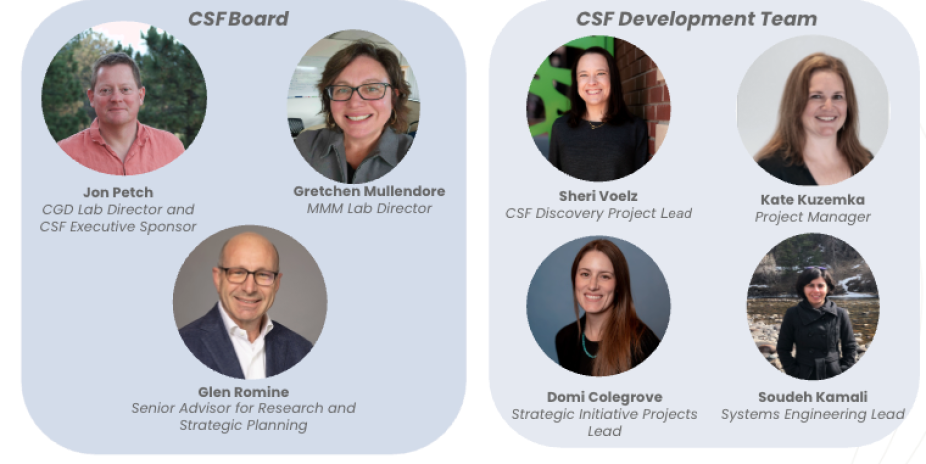
The People Behind the Design and Delivery of the CSF
Questions? For more information or opportunities to get involved, please contact: csf@ucar.edu