Focus Area: Space Weather Predictability
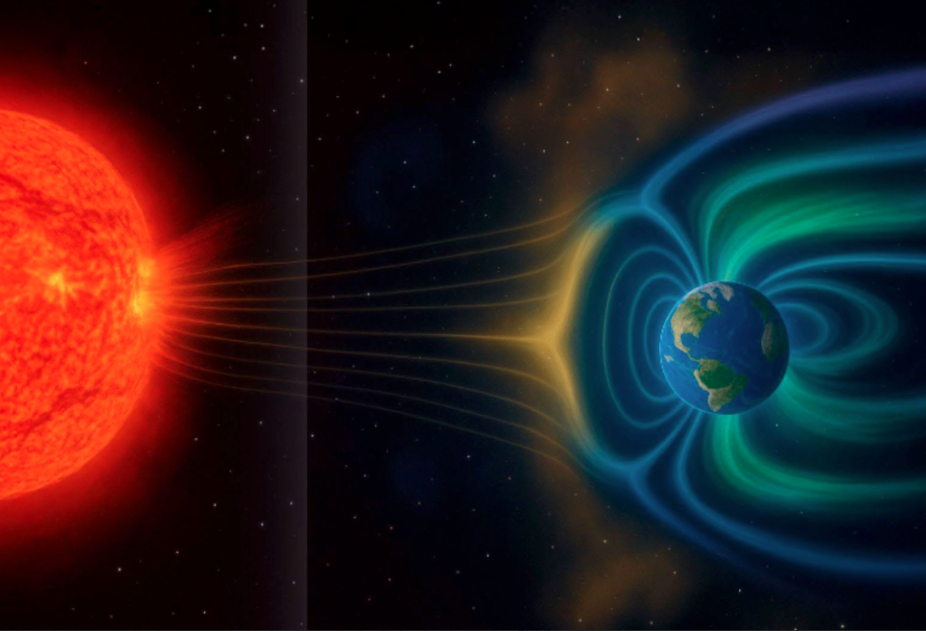
The NSF NCAR Earth System Predictability Across Timescales (ESPAT) initiative has partnered with the Coupling, Energetics and Dynamics of Atmospheric Regions Program (CEDAR) to advance understanding of space weather predictability. In 2026, CEDAR launched a three-year Grand Challenge, Cross-Scale Coupling and Variability in the Upper Atmosphere and Ionosphere — Pathways to Improved Space Weather Predictability. The Grand Challenge builds on the ESPAT approach of bringing together researchers across disciplines, institutions, and sectors to identify key sources of predictability, develop coordinated research activities, and advance predictive capabilities through team science.
The effort is organized around three major science questions, and advancement happens through coordinated working groups that provide a structure for focused scientific collaboration through team science approaches.
Three Science Questions
The CEDAR-ESPAT Space Weather Predictability effort is organized around three overarching questions:
- How can the variability and cross-scale interactions of drivers from the Sun–magnetosphere system and the lower atmosphere be more accurately characterized and represented to improve understanding and prediction of Ionosphere-Thermosphere (IT) variability?
- How do background conditions and cross-scale coupling pathways regulate the response of the IT system to external forcing and shape space weather variability?
- What are the sources and limits of predictability in the coupled IT system, and how can coordinated use of observations, models, data assimilation, and artificial intelligence (AI) and machine learning (ML) improve predictive capability?
Working Groups
The working groups provide a structure for focused scientific collaboration while maintaining strong connections across the coupled Sun–Earth system. Participants may contribute to more than one working group, helping build connections across scientific disciplines and research communities. Scientists from the CEDAR community, NSF NCAR, NOAA, universities, industry, and international partners are participating in five working groups:
- Solar and Geomagnetic Forcing Predictability
- Lower Atmosphere Forcing and Whole Atmosphere Coupling
- Ionosphere-Thermosphere System Response and Predictability
- Rocket Emissions and Space Reentry
- Data Assimilation and Artificial Intelligence
Each working group meets approximately every 4–6 weeks. All working groups come together approximately quarterly to share progress, identify cross-cutting scientific opportunities, and develop coordinated activities. The groups are working toward community activities and scientific products to be developed between annual CEDAR Workshops.
Advancing Space Weather Predictability through Team Science
The effort aims to integrate observations, modeling, data assimilation, and AI/ML to address space weather predictability. Particular emphasis is placed on a team science approach that brings together expertise across disciplines, communities and areas of expertise to address questions that span scientific boundaries. Through this collaborative approach, we seek to understand how forcing from above and below, IT background conditions and internal processes, and their coupling interact across spatial and temporal scales to shape the predictability of the IT system. This integration of diverse expertise also helps strengthen connections between fundamental science and applications such as satellite operations, communications, navigation, and space re-entry.
The Grand Challenge provides a three-year structure for advancing team science through coordinated research activities, strengthening connections between the CEDAR and broader Earth-system communities, and identifying pathways toward improved space weather prediction.
CEDAR-ESPAT Grand Challenge Leadership Team
Interested in participating?
If you are interested in joining any of the CEDAR-ESPAT space weather working groups, please fill out this interest form.
Questions?
Contact espat-swx-leadership@ucar.edu.