Earth System Emulators
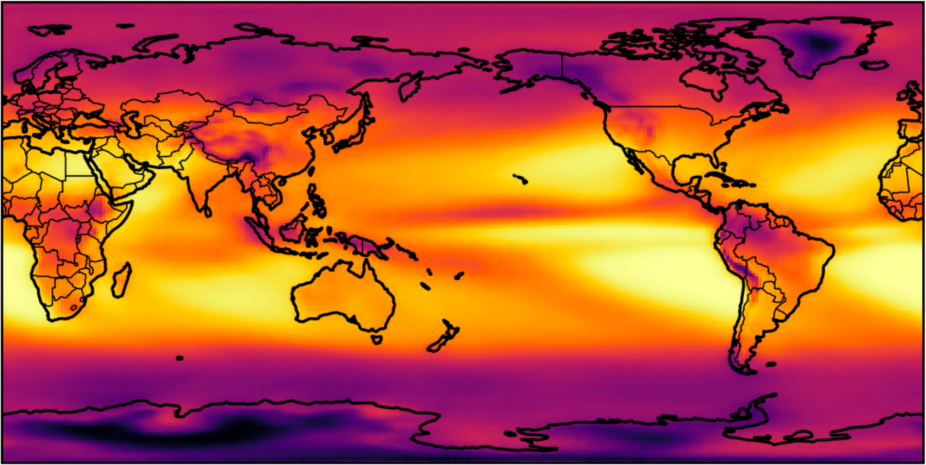
In just a few years, purely data-driven weather models—trained primarily on ERA5 reanalysis data—have, by many metrics, surpassed the skill of traditional physics-based models that have been under development for decades. The emergence of Artificial Intelligence–based weather prediction (AIWP) has generated both disruption and excitement within the forecasting community. AIWP models can be run at a fraction of the computational cost of physics-based models and can produce forecasts in minutes rather than hours. This dramatic reduction in cost and runtime opens new scientific opportunities, such as running ensembles with hundreds or even thousands of members, potentially leading to improved understanding of rare and extreme events.
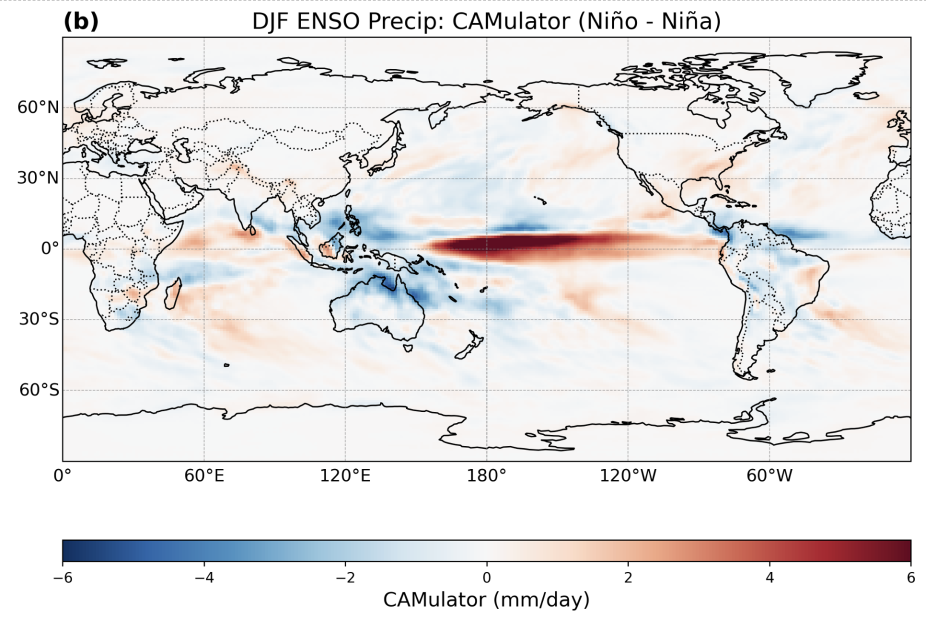
More recently, deep learning models have been trained on other data sources, including outputs from traditional physics-based models, enabling applications beyond short-range weather forecasting, such as subseasonal-to-seasonal prediction. NSF NCAR is actively developing new emulators to better understand their potential applications across the Earth system sciences and to enable the broader community to experiment with them in support of their own research. Several models that are either currently available or soon to be released are listed below. NSF NCAR has already developed several open-source AI models and will continue to develop more with and for the Earth system science community. Currently available models, developed in the CREDIT framework, include:
- WXFormer – A multiscale vision transformer developed specifically to explore innovative approaches to weather prediction
- CAMulator – An ML emulator of the Community Atmosphere Model (CAM)
- subCESMulator – ML-based emulator integrating atmosphere, ocean, and land components for subseasonal prediction research
Interactive emulator intercomparison
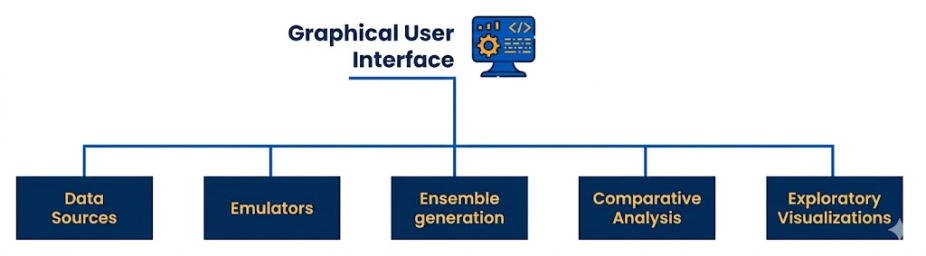
As the number and diversity of AI/ML-based emulators grow, so does the challenge of performing meaningful exploratory analysis, ad hoc experimentation, and intercomparison across models and ensembles. Systematic intercomparison is essential for understanding model behavior, identifying strengths and failure modes, and assessing robustness across regimes. Yet the scale and dimensionality of high-resolution, spatiotemporal outputs increasingly limit what can be explored with static analysis and visualization tools.
To address this need, NSF NCAR has developed and continues to develop interactive platforms that enable users to run inference with multiple AI/ML emulators and perform qualitative intercomparisons. Leveraging our experience with large-scale visualization and analysis platforms, these tools support rapid experimentation with ensembles and lead times, coupled with interactive visualization and analysis workflows, lowering the barrier to rigorous, community-driven evaluation and benchmarking of AI-based Earth system emulators. A web-accessible service for browser-based experimentation, based on these capabilities, is planned for deployment to the community later this year.
For more information or for partnership opportunities, please contact John Clyne.