CREDIT
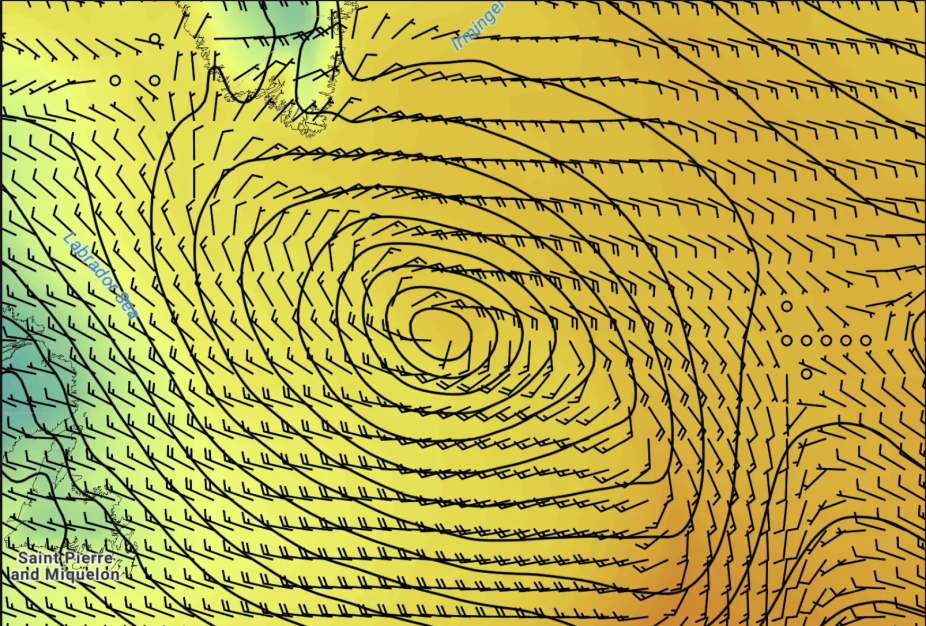
Community AI Model Framework + Our Community Research Earth Digital Intelligence Twin (CREDIT)
NSF NCAR fully embraces community-driven open source development—a collaborative model in which software is created, maintained, and advanced by a broad community united by a shared scientific vision. Flagship community codes such as the Community Earth System Model (CESM), the Community Atmosphere Model (CAM), and the Model for Prediction Across Scales (MPAS) are developed through open repositories, transparent governance, and community review. This open model promotes reproducibility and scientific integrity, accelerates innovation through broad participation, reduces duplication of effort across institutions, and builds shared infrastructure that can endure beyond individual projects or funding cycles. A global community of geoscientists and research software engineers sustains this ecosystem by contributing code, documentation, and tests; participating in issue tracking and peer review; and improving performance, portability, and usability. Equally vital are non-code contributions—including user support, training materials, tutorials, and community coordination—which expand and diversify the contributor base across NCAR’s portfolio of models and tools.
As NSF NCAR advances transformative AI/ML technologies for Earth system science, we are extending this same open development philosophy to data-driven models, training frameworks, and deployment services. Our commitment to responsible and ethical AI requires transparency in model architectures, training datasets, preprocessing pipelines, evaluation metrics, uncertainty characterization, and version histories. Open development enables independent validation, facilitates benchmarking and intercomparison, and supports reproducibility in a domain where model behavior can be sensitive to training data and implementation choices. By treating AI/ML models as community scientific infrastructure—rather than isolated research artifacts—we aim to ensure they are trustworthy, well-documented, rigorously evaluated, and sustainably maintained for the benefit of the broader scientific community.
Learn more about NCAR’s open development practices and how you can get involved with these packages:
For more information or for partnership opportunities, please contact John Clyne.
Community Research Earth Digital Intelligence Twin (CREDIT): A community framework for training and deploying AI-based Earth System Science models
What is CREDIT?
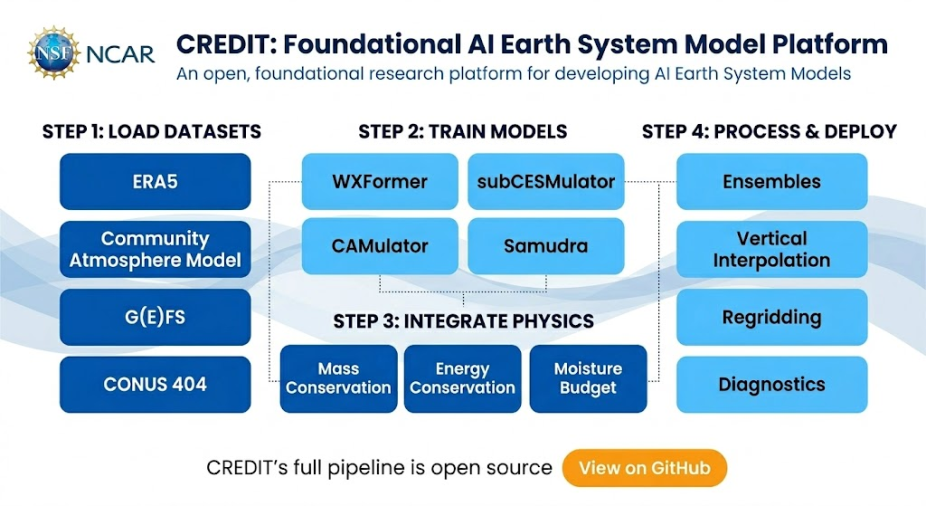
CREDIT is an open, foundational research platform for developing AI Earth System Models.
CREDIT enables users to:
- Load large datasets
- Train customizable AI models at scale
- Deploy models for forecasting, hindcasting, or projections
CREDIT’s full pipeline is open source and being developed openly.
Traditional numerical models of the Earth system differ from emerging data-driven deep learning models in several important respects, particularly in terms of generality and adaptability. Physics-based models derive their flexibility from underlying conservation laws and can often be adapted to new scientific questions by modifying boundary conditions, parameterizations, or coupling configurations. In contrast, adapting a data-driven model—such as those used in AI-based weather prediction (AIWP)—to a new problem typically requires retraining or fine-tuning the model using different datasets and, in some cases, modifying the architecture itself. As a result, applying AIWP approaches to new research questions depends critically on the ability to train and retrain models efficiently.
Fortunately, a mature ecosystem of widely used, domain-agnostic open-source software frameworks—such as PyTorch and JAX—now provides robust tools for developing and scaling deep learning models. Building on this foundation, and in response to strong community interest in AIWP and related scientific domains, NSF NCAR has developed the open-source Community Research Earth Digital Intelligence Twin (CREDIT) framework. CREDIT provides a flexible, scalable, and user-friendly platform for training and deploying AI-based ESS models on high-performance computing systems. By offering an end-to-end pipeline that supports data preprocessing, model training, evaluation, and deployment, CREDIT lowers technical barriers. It democratizes access to advanced AI-enabled Earth system modeling capabilities for the broader community. CREDIT’s flexible architecture and support for physical constraints - such as conservation of mass, water, and energy - permit the development of a wide range of Earth system emulators, with applications such as global atmospheric modeling, ocean modeling, and subseasonal prediction. The development of CREDIT follows a community-driven, open development model that encourages and facilitates contributions from the broad ESS research community.
Learn more about and start using CREDIT.
For more information or for partnership opportunities, please contact John Clyne.