Core Principles for Responsible and Reliable AI in Earth System Science
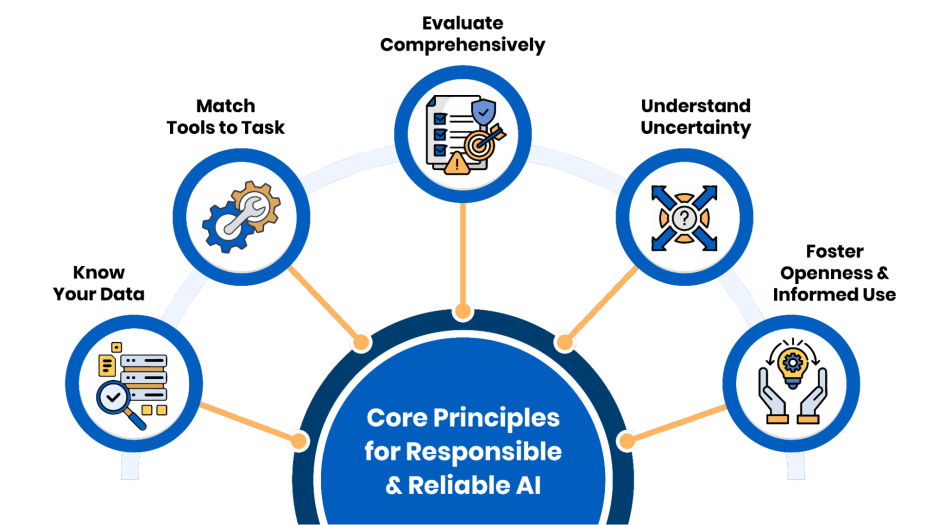
Our recommendations for responsible and reliable AI are grounded in established best practices and draw on the growing body of responsible AI research within Earth system science and related disciplines.
(1) Know Your Data
Understand where your data comes from, what it actually measures, and whether it includes the information needed for your specific question or application. Check that your data covers the correct time periods, geographic areas, and conditions relevant to your study and modeling. This includes verifying that datasets capture physical processes, phenomena, and scales of interest, and being aware of gaps, limitations, or issues that could affect your results.
(2) Match Tools to Tasks
Choose AI approaches that are well-suited to your specific problem and use traditional methods when they are more appropriate. Make sure the AI tools you select or build are designed for applications like yours, and understand what they are good at and where they have limitations. This means assessing whether the complexity and capabilities of an AI approach align with your scientific questions, available data, and the level of interpretability or physical consistency with your applications.
(3) Evaluate Comprehensively
Test how well your AI tools perform across different situations and conditions, evaluating them against a dataset other than the one they were trained on. When using existing AI models or tools, check whether they have been thoroughly tested for the specific application you have in mind. This includes verifying that model outputs align with physical laws and established scientific understanding, and assessing performance across diverse real-world scenarios, including extreme, unusual, or novel conditions.
(4) Understand Uncertainty
Learn about, and be able to identify, sources of uncertainty, error, and bias in both the data you use and the models you build or apply. Work to quantify those where possible and communicate them clearly so users understand the confidence they should have in your results. Understanding how these factors affect your conclusions helps ensure appropriate interpretation and application of AI outputs and tools.
(5) Foster Openness and Informed Use
Document your methods, data sources, and decisions so that others can understand, reproduce, and build on your work. Share your code, models, and findings openly, along with clear guidance on what your AI tools are designed to do, where they work best, and their limitations. This transparency enables community learning and collaborative improvement, and ensures that other users and adopters have all the information needed to apply AI tools responsibly and reliably in their own contexts.