How Users Evaluate and Rely on AI
It is easy to assume that users’ confidence in an ML model is something engineers can simply build into a system, such as by making it accurate, consistent, or error-free. While those technical qualities matter, they don’t capture everything important about an AI model. Whether a model is credible enough to act on — what the research literature calls “trustworthiness” — is not a property of the AI itself, but a judgment made by the people who use it. That judgment is both perceptual (i.e., shaped by how a user experiences and evaluates a tool) and context-dependent, varying based on who is using the AI system, what decisions are at stake, and the specific situation they find themselves in. A weather forecaster working under time pressure, for example, might rely on an AI model based on criteria very different from those of a policymaker reviewing long-term projections of how flood hazards will change.
This distinction matters because much of AI development focuses on the model itself, while the people who use the system and depend on it often receive less attention. If a tool is built to high technical standards but users don’t understand it, can’t interpret it, or don’t feel confident in its ability to perform well in the situation they are working in, it won’t be considered credible or used.
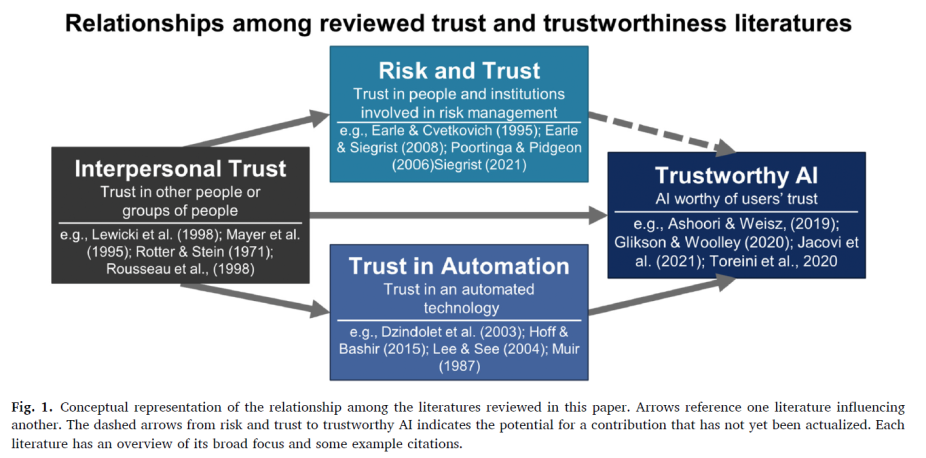
Figure: Conceptual representation of the relationship among the literatures reviewed in Wirz et al. 2025.
Researchers at NSF NCAR are working to close the gap between systems and their users. In close collaboration with university partners, stakeholders, and domain experts, they are studying how real users perceive and evaluate AI models. Their findings about how different users come to rely on these systems inform our practices for designing new tools that are driven by user needs and reflect user preferences. The research also helps inform the development of methods to make AI more transparent and reproducible, and directs future development towards user experience. The goal is to ensure that as AI becomes more embedded in high-stakes fields such as weather and hazard prediction, the people relying on these tools have both good reason and the right conditions to rely on them.
For more information or for partnership opportunities, please contact Julie Demuth.
Papers published by NSF NCAR researchers on this topic: