Community Support
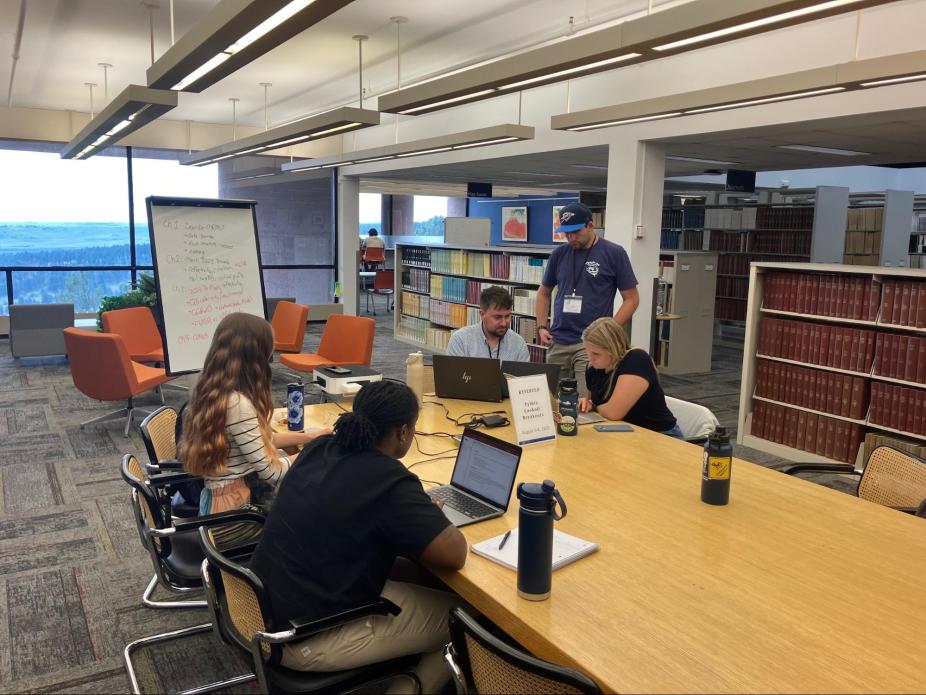
Figure: Photograph taken at an annual NSF NCAR “Pythia Cook-off” community hackathon where attendees collaborate to create open-source Cookbook resources for the global scientific community. These cookbooks are supported by a rich GitHub-based infrastructure enabling collaborative authoring and automated health-checking to ensure reproducibility.
Adopting AI in Earth system science demands skills that span ML, HPC, and domain science. A major strength of NSF NCAR's cyberinfrastructure is dedicated, domain-aware support staff who bridge these disciplines, maintaining computing environments optimized for NSF NCAR's GPU-accelerated systems, providing consulting and hands-on training, and helping hundreds of researchers run, scale, and optimize AI workflows from training through inference.
NSF NCAR’s expert consulting staff can guide researchers in training and optimizing large Earth system ML models across many GPUs using software stacks and workflows familiar to the ESS community and optimized for NSF NCAR HPC hardware. Training resources, community channels, curated tutorials, and ready-to-run computational notebooks extend this support beyond one-on-one consulting to the broader community.
These resources are designed to be accessible and easy to use, lowering the barrier to AI adoption at every experience level.
Examples:
- NSF NCAR consultants worked with domain scientists and ML experts to help develop the CREDIT framework, ensuring the infrastructure is production-ready, well-tested, and optimized for NSF NCAR's HPC systems.
- University classroom AI weather prediction workflows: Accessible exercises that allow students and new users to run state-of-the-art AI forecasts.
- AI-ready data pipeline optimized for large-scale training workflows
- Workflow parallelization to support S2S ensembles.
Consulting Help:
- Research Computing Help Desk: ithelp.ucar.edu or call 303-497-2400
- Virtual Consulting and Office Hours
- Workforce Development learning resources
Geoscience Data Exchange (GDEX)
- Search for datasets in GDEX
- Add data you need into the research data commons
- Reference AI-ready dataset development and pipelines
- Build off of our data ingestion examples
- Need help? Please reach out to the GDEX Help Desk or email datahelp@ucar.edu
Compute Access Eligibility
NSF NCAR provides a range of allocation opportunities to support U.S.-based Earth system science researchers and students — both with and without NSF awards.
In general:
- U.S.-based researchers with an NSF award in Earth system science or a related field are eligible for university allocations.
- Small allocations and dedicated opportunities are available for graduate students, postdocs, and early-career faculty without NSF awards.
- Classroom and workshop allocations support educational activities, including running and teaching AI models for Earth system science (no NSF award required).
Learn more about allocations: