AI Data Assimilation for Weather and Extreme Event Prediction
The Pangu-DART effort, developed in collaboration with scientists at the University of Oklahoma, advances NSF NCAR’s leadership in combining AI with rigorous data assimilation (DA) for next-generation weather forecasting. ML models such as Pangu-Weather (Bi et al., 2023) can produce global forecasts at a quarter of a degree resolution in about 10 seconds on a single GPU, dramatically reducing computational cost compared to traditional systems. This efficiency enables large ensembles needed for DA, which rely on many members to accurately represent forecast uncertainty. To leverage this capability, a new interface links Pangu-Weather with NSF NCAR’s Data Assimilation Research Testbed (DART; El Gharamti et al., 2025), allowing ensemble DA cycles to operate directly with an AI forecast model. Implementation details are available in the official documentation.
Demonstration experiments highlight the scientific impact of this integration. For Hurricane Milton (October 2024), track comparisons show the observed best track alongside the Pangu-Weather forecast ensemble mean, and the Pangu-DART analysis ensemble mean, with individual ensemble members plotted to illustrate uncertainty. The assimilation pulls the forecast closer to observations, illustrating how combining AI forecasting with DART improves prediction accuracy for high-impact events.
For more information or partnership opportunities please contact, dart@ucar.edu
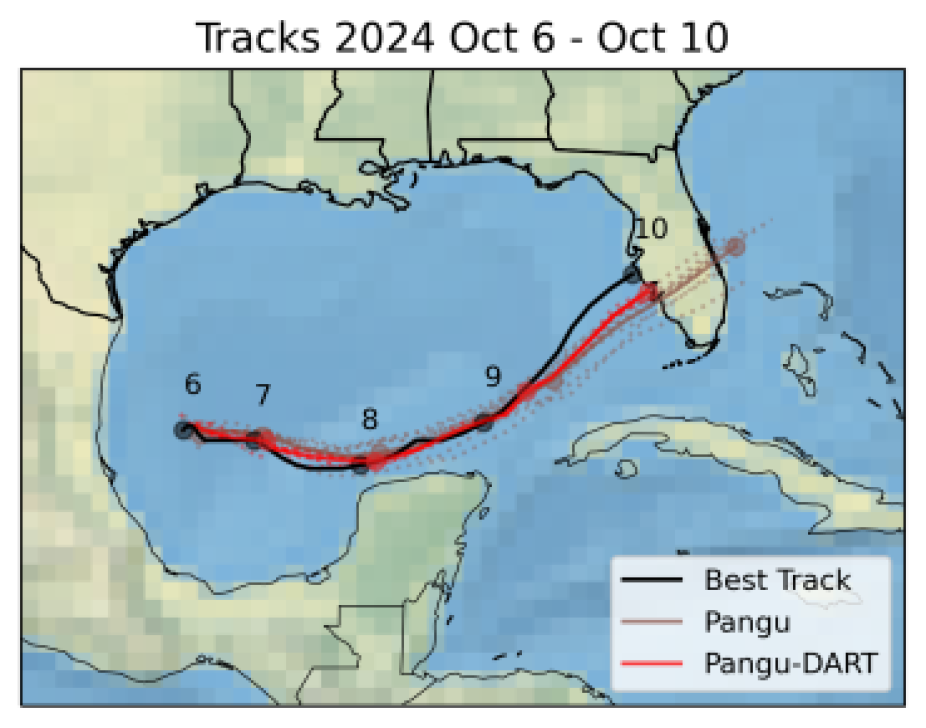
Figure: Tracks of Hurricane Milton (6-10 Oct 2024) from the International Best Track Archive (black), Pangu-Weather forecast ensemble mean (brown), and Pangu-DART analysis ensemble mean (red). Individual ensemble members are shown with dotted lines.