Weather Radar Signal Enhancement with Deep Learning
Artificial intelligence (AI) can improve how weather radar systems observe storms and atmospheric conditions. By combining traditional radar measurements with AI models, scientists can generate faster, more detailed radar observations without collecting as much raw data.
This approach uses an AI-enabled radar system that uses an LSTM model designed to recognize patterns in sequential dataneural network sequences to predict radar signals, enabling faster, more accurate radar observations over time. By synthesizing extended time series from a subset of real-time measurements, the AI radar learns and improves the accuracy and spatial resolution of radar signal measurements without requiring the radar to spend more time observing each location (longer dwell times).
Because the AI can fill in missing portions of the radar signal, the proposed technique offers higher temporal and spatial resolution observations, reduces data collection time and storage demands, and maintains the statistical and spectral characteristics of radar signals. This reduces the time needed for measurements and lowers the amount of data that must be stored, while still preserving the key characteristics of the radar signal.
This AI radar technique demonstrates promising improvements in radar observations across ground-based, airborne, and spaceborne platforms. This advance opens new possibilities for classical and phased-array radar systems.
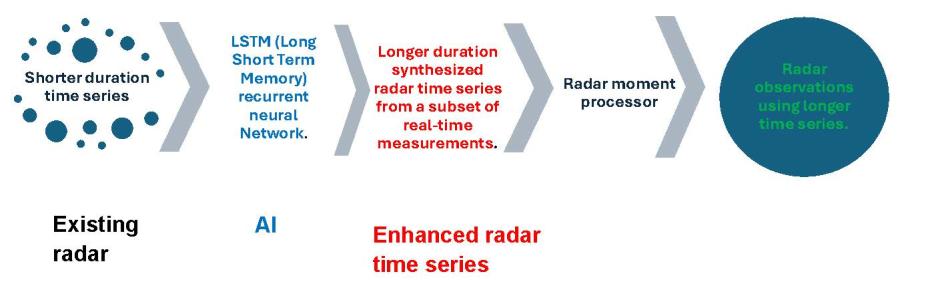
Fig.1. Overview of the conceptual AI-based weather radar. A conceptual process flow diagram (Fig. 1) illustrates how an LSTM network can be integrated into an existing radar system. Typically, the AI radar requires only 25% of the measured time-series data, while the remaining 75% is predicted using an LSTM neural network. To create a longer time series, the measured 25% is combined with the predicted 75%. The radar observations are then derived from this synthesized longer time series. For more see https://agupubs.onlinelibrary.wiley.com/doi/full/10.1029/2025RS008417#
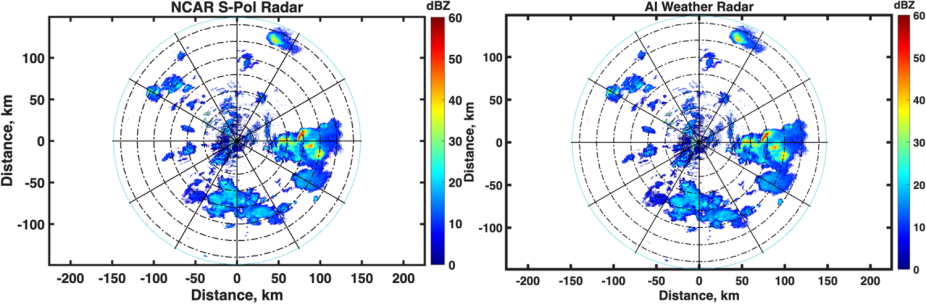
Figure 2. Comparison of reflectivity, measured by the NCAR S-Pol radar and AI weather radar. AI radar estimates show a good agreement with NCAR S-Pol radar measurements. Figure 2 shows radar observations from S-Pol and AI weather radar. The AI radar was trained on simulated radar time-series signals (I/Q). The LSTM neural network used the initial 16 time-series samples to predict the next 48 time-series samples. The plots in the left figure were obtained from all 64 measured samples. The right figure radar measurements used 16 measured and 48 predicted radar signal samples. The AI radar utilized only 25% of the measurements, and the LSTM NN predicted the remaining 75%.
Importantly, the proposed method can be used with any radar that measures in-phase and quadrature (I/Q) time-series data, because it works directly with the fundamental radar signal data. This method is not restricted to a specific radar platform; it can be used with ground-based radars, airborne systems, spaceborne systems - like satellites, wind profilers, phased-array radars, and both scanning and non-scanning radars.
For more information or partnership opportunities, please contact Jothiram Vivekanandan.