AI DART Hydro-DART for Flood Prediction
Hydro-DART is NSF NCAR’s coupled flood-prediction and data assimilation (DA) capability that brings together the WRF-Hydro National Water Model (NWM) configuration and NSF NCAR’s Data Assimilation Research Testbed (DART; El Gharamti et al., 2025) to produce ensemble streamflow analyses and short-range forecasts for high-impact events. Built to address the core challenge of flood prediction during extreme rainfall, the system assimilates instantaneous streamflow observations to correct hydrologic initial conditions on hourly cycles and improve the timing and magnitude of flood peaks. Hydro-DART uses state-of-the-art DA tools, including multi-physics ensembles, adaptive inflation, Along-The-Stream (ATS) Localization, and hybrid ensemble and optimal interpolation schemes. Learn more about the system: El Gharamti et al. 2021; El Gharamti et al. 2024.
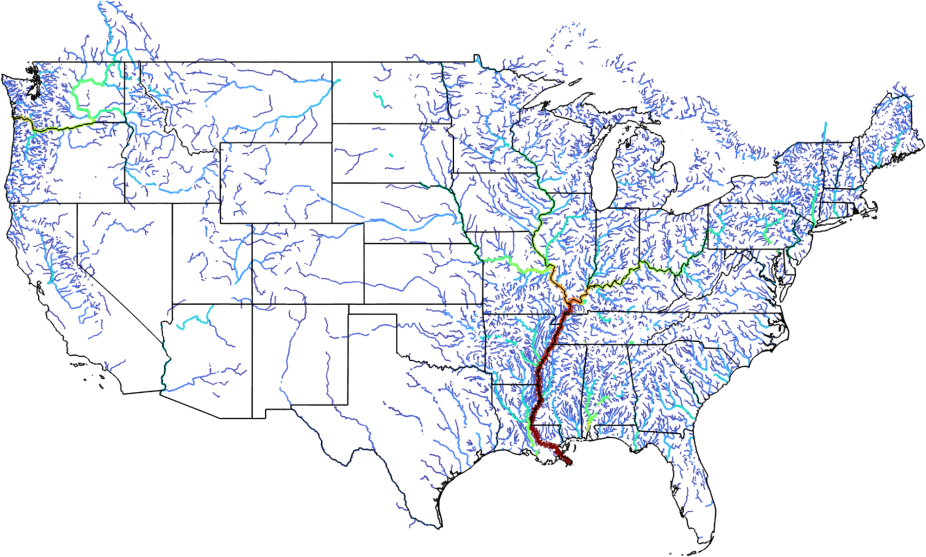
Figure: The map illustrates streamflow conditions across CONUS on 26 July 2022, averaged over 80 ensemble members; thicker river reaches indicate stronger streamflow.
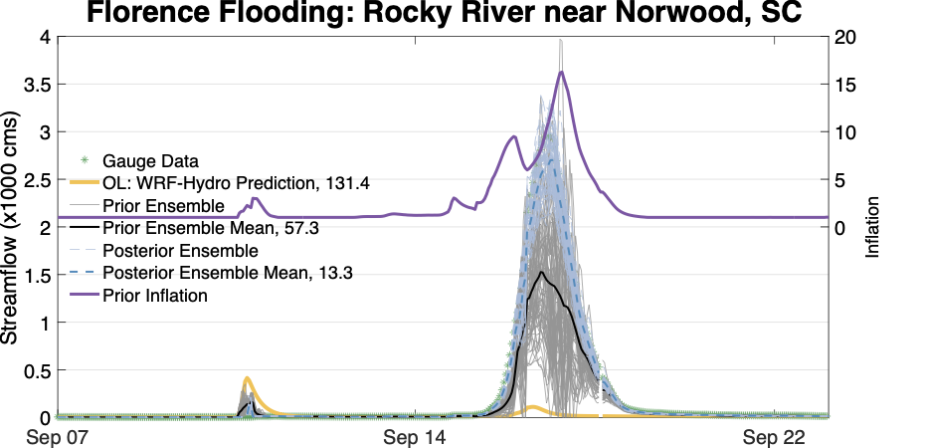
Figure: The hydrograph compares Hydro-DART prior and posterior streamflow estimates with observed discharge and the model’s simulation during Hurricane Florence (2018) at the Rocky River near Norwood, South Carolina. Also shown to the right is the time evolution of adaptive covariance inflation generated by DART.
Hydro-DART also provides a pathway for AI-augmented hydrologic DA at NSF NCAR, with three active development directions: (1) fast surrogates for urban inundation modeling, replacing expensive hydrologic solvers to enable rapid neighborhood-scale flood updates; (2) generative AI methods to create physically consistent pseudo-observations in ungauged basins, improving information propagation where in-situ networks are sparse; and (3) emulation of expensive upstream components (e.g., land model) to make strongly coupled DA feasible at large scales and higher update frequency.
For more information or partnership opportunities, please contact: Moha Gharamti.