Digital Twin of the Sun
Solar observations are inherently limited. Most measurements provide two-dimensional projections of a complex three-dimensional atmosphere, and the magnetic field, which drives solar flares and eruptions, is routinely measured only at the solar surface. In the solar corona, the Sun’s hot outer atmosphere, emission from different depths overlaps along the line of sight, making it difficult to determine the true spatial distribution of plasma and magnetic fields. Observations alone, therefore, cannot uniquely determine the 3D magnetic topology or plasma structure that governs solar activity — a fundamental limitation for understanding and anticipating the solar eruptions that drive space weather.
Researchers at NSF NCAR develop artificial intelligence methods that combine physical models and observations to reconstruct the three-dimensional structure of the Sun to improve our physical representation of the solar drivers of space weather.
To estimate the magnetic field in the corona, researchers use Physics-Informed Neural Networks that embed the equations of magnetohydrodynamics - a branch of physics that studies the behavior of electrically conducting fluid in the presence of a magnetic field to observe how they interact with and influence each other- directly into a neural representation. This approach reconstructs a continuous three-dimensional magnetic field that is consistent with both surface measurements and physical laws. It enables data-constrained modeling of magnetic energy storage, topological changes, and the conditions that precede solar eruptions - processes that ultimately determine the timing and intensity of space weather events.
To reconstruct the three-dimensional plasma distribution, Neural Radiance Field methods are applied to multi-viewpoint extreme ultraviolet and white-light observations. These tools already provide time-dependent 3D reconstructions of coronal emission and density, capturing the structure of large-scale solar features and evolution of coronal mass ejections that propagate through interplanetary space and interact with Earth’s magnetosphere. This improves the interpretation of complex image sequences and provides physically meaningful plasma constraints that can be directly coupled to magnetic field models.
Current efforts focus on integrating these capabilities into a unified, data-assimilative AI-powered framework. The goal is to build a coherent three-dimensional representation of the solar atmosphere that couples magnetic fields and plasma within a single physical model - a digital twin of the Sun.
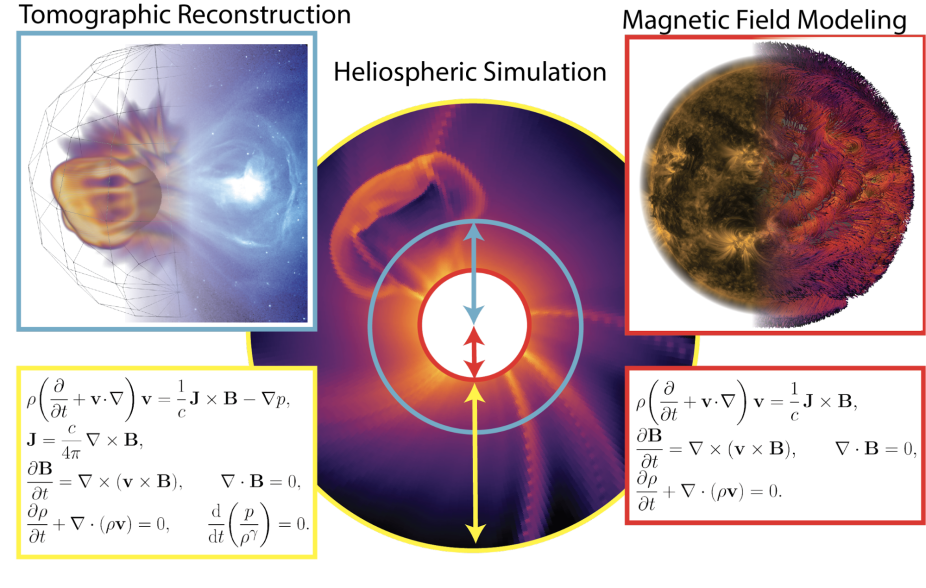
Figure: A unified physics- and data-driven framework for the solar atmosphere: PINN-based magnetic field modeling in the lower atmosphere (red) and NeRF-based tomographic reconstructions of coronal plasma (blue).
By converting limited two-dimensional observations into physically consistent three-dimensional reconstructions, this research improves our understanding of coronal magnetic topology, energy storage and release, and the dynamic evolution of solar eruptions. These advances provide a more complete picture of how magnetic fields and plasma interact in the solar atmosphere and strengthen the scientific foundation for space weather research.
Selected related studies
- Jarolim et al. (2023), Probing the solar coronal magnetic field with physics-informed neural networks, Nature Astronomy
- Jarolim et al. (2024), SuNeRF: 3D Reconstruction of the Solar EUV Corona Using Neural Radiance Fields, The Astrophysical Journal Letters
- Jarolim et al. (2024), Advancing Solar Magnetic Field Extrapolations through Multiheight Magnetic Field Measurements, The Astrophysical Journal Letters
- Jarolim et al. (2024), Magnetic field evolution of the solar active region 13664, The Astrophysical Journal Letters
- Jarolim et al. (2026), SuNeRF-CME: Physics-Informed Neural Radiance Fields for Tomographic Reconstruction of Coronal Mass Ejections, under review
For questions or partnership opportunities, please contact Robert Jarolim.