PINNBARDS: Physics-Informed AI for Global Solar Storm Prediction
Joint NSF NCAR-SwRI tool integrates global solar active region observations with a physical model and AI
(Article from UCAR News)
Researchers at NSF's NCAR High Altitude Observatory (HAO) lab and the Southwest Research Institute developed PINNBARDS (PINN-Based Active Regions Distribution Simulator), an AI-enabled forecasting tool that links surface observations of the Sun to magnetic processes deep within it. The PINNBARDS system uses a type of artificial intelligence called a physics-informed neural network, which combines satellite data with established physical MHD model equations to reconstruct the Sun’s hidden magnetic structure - the source of powerful space weather events called solar storms.
This approach represents a major step forward for space weather forecasting. Today, forecasts often provide only a few hours' notice before a solar storm that can cause issues such as power grid disruptions, satellite damage, service interruptions, and disruptions to the earth’s atmosphere, putting astronauts, aviation, and many forms of technical communication, such as the internet infrastructure, at risk. All of these disruptions can have major economic impacts by causing cascading failures in interconnected systems.
PINNBARDS opens the door to predicting flare-producing solar activity weeks in advance, giving agencies and industries more time to prepare for disruptions to GPS systems, satellites, power grids, communications infrastructure, and astronaut safety.
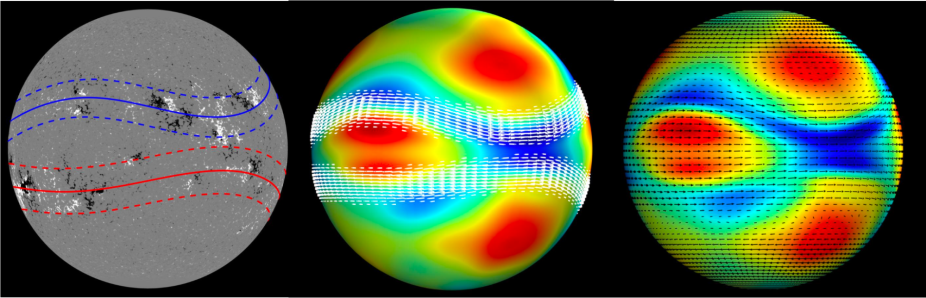
Figure: Top panel (gray-scale map): Two warped-toroid patterns displayed in the north (blue) and south (red) hemispheres. Solid curves in blue and red, respectively, denote the central latitudes of the active regions (AR) distributions in north and south; blue (red) dashed curves on both sides of the solid blue (red) curve imply the width of the toroidal band in which ARs are strung. Absolute longitude (Carrington longitude) is shown on the top x-axis. In contrast, the bottom x-axis will be used in the PINN model, and later, PINN solutions will be compared with observations along the bottom x-axis.
Mausumi Dikpati ran simulations on NSF NCAR’s High Performance Computer (HPC) Derecho supercomputer, demonstrating how AI, high-performance computing, and domain science can work together to advance Earth and space system prediction, accelerate scientific discovery, and improve societal resilience.
Read the full article. For more information or for partnership opportunities, contact Mausumi Dikpati.